
From Pornography to Professional Writing: My Unlikely Journey
I Never Stopped Writing. I Just Stopped Writing for Everyone Else.
I was 22 when I received what might have been my first writing commission.
Pornography.
Not exactly the sort of thing you put on your résumé, but we all have to start somewhere.
I’d known this bloke since I was about 12 or 13. He was a friend of the family. We’d grown up knowing each other, and there had never been anything romantic between us.
Nothing. Not a kiss. Not a fumble behind the bike sheds.
Just friends.
He’d taken a slightly different career path to mine.
Crime.
Nothing particularly sophisticated. Petty theft to support a drug habit. No criminal mastermind. No elaborate bank heists. Just a young bloke making some pretty ordinary decisions.
Eventually, those decisions landed him in prison.
And that’s where my literary career took an unexpected turn.
My first writing commission
One day, he made a request.
“Hey, darling, can you write me some porn?”
Now, I don’t know what other 22-year-old women were doing with their spare time, but apparently I was about to become a freelance erotic novelist.
“Oh, look, I’ll try,” I said.
And I did.
I sat down with a pen and lined foolscap paper and started writing.
Not a love letter.
Not a little flirtatious note.
A full-blown, sexually explicit story.
Five pages.
Possibly five and a half.
Handwritten.
I can’t remember a single word of it now, which is a shame because, for all I know, it could have been magnificent.
It could have been dreadful too.
We’ll never know.
There was no computer, no Word document, no cloud backup and certainly no artificial intelligence offering to improve my sentence structure.
Just me, a pen, some paper and a rather unusual creative brief.
When I’d finished my masterpiece, I folded the pages, put them in an envelope and posted them to prison.
Imagine that.
Somewhere in the Australian postal system was five and a half pages of handwritten erotica, travelling towards a correctional facility.
No internet.
No attachments.
No password-protected PDF.
Just Australia Post doing its bit for the arts.
The reviews are in
Well, apparently he enjoyed it.
So much so that he shared it with his mates.
Now, what happened to those five and a half pages after they arrived was none of my business.
I’d written it for one person.
One.
What he chose to do with it afterwards was entirely up to him.
And there you have it.
My first piece of creative writing with an audience beyond its intended recipient.
No publisher.
No marketing campaign.
No literary agent.
And absolutely no royalties.
Just me, a Bic pen and an audience that wasn’t going anywhere.
I never did get published in Playboy.
Then again, I never submitted anything.
I’d been commissioned by a friend, and I delivered.
Talk about knowing your target audience.
From pornography to swimming pools
Somewhere along the way, my writing took a considerably more respectable turn.
Swimming.
Yes, from handwritten erotica to educational swimming programs.
There’s a career progression you don’t see on LinkedIn every day.
Around the year 2000, I completed all six AUSTSWIM courses available to me. One core course and five electives.
I was immersed in swimming education, learning how to teach, how people develop skills and how to structure lessons.
Eventually, I started running adult swimming classes at East Leagues Club in Bondi Junction.
Adult learn-to-swim and swimming squads.
And I loved making those classes fun.
My squads weren’t just endless laps of staring at the black line on the bottom of the pool.
We stretched beforehand. We mixed up the laps. Different combinations, different exercises, different challenges.
Anything to stop people getting bored.
Because let’s face it, swimming up and down a pool doing the same thing can become mind-numbingly dull.
My beginners had fun too.
And that mattered.
Especially with adults.
Adults are not oversized children
Teaching an adult to swim is an entirely different experience from teaching a child.
Children can be frightened of water without necessarily understanding why.
Adults often arrive with a lifetime of experiences, fears, embarrassment and very clear ideas about what they can and cannot do.
Some know exactly why they’re frightened.
Others don’t.
Then there are the differences in physical ability, coordination, confidence and the way adults process information.
You can’t simply take a children’s swimming lesson, make the participants bigger and expect the same teaching methods to work.
I’d learnt that through experience.
I had around sixty adults attending my swimming programs.
Sixty!
And we were having a great time.
Because teaching people something difficult doesn’t mean the experience has to be miserable.
Around that time, AUSTSWIM was considering developing an adult learn-to-swim syllabus.
I knew the organisation through my training and involvement in swimming education, and when the subject came up, I had plenty to say.
They mentioned that teaching adults was difficult.
“Well, they’re not,” I said. “I’ve got sixty of them!”
And then I explained what we were doing.
How adults learn differently. How their fears differ. How their physical and cognitive skills need to be considered. How to create lessons that build confidence rather than simply demand performance.
I wrote an outline for them to consider.
Not the syllabus itself. I supplied its framework.
It took me about half an hour to write.
They were so appreciative that they gave me a couple of hundred dollars.
I can’t remember the exact amount.
But I remember how straightforward it felt.
I knew my subject.
I knew what I wanted to say.
And I knew how to put it into words.
Apparently, I wrote children’s shows too
And then there were the educational productions.
I’d almost forgotten about those.
Not little worksheets or a few paragraphs of instructions.
Complete educational programs.
Two of them.
One grew out of the swimming world through Mega Swim School. The other was developed through a business called J & T Natural Toys, short for Jacqueline and Tara Natural Toys.
Both involved music, scripts, performances and teaching materials.
And both had pantomimes.
Actual shows.
Which I wrote.
And performed in.
The lobster years
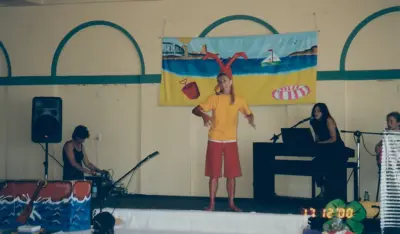
In the swimming production, I played a lobster.
A sunburnt lobster.
My arms and legs were painted bright red, and sticking out of my head were two magnificent antennae, fashioned from empty paper towel and toilet rolls, joined together and painted red.
Not exactly Hollywood special effects, but we worked with what we had.
There I was, standing on stage in my homemade lobster costume, teaching children about the dangers of sunburn.
Because swimming education wasn’t just about learning to float and kick.
There was water safety, not running around the pool, sun protection and all the other things children needed to understand.
And apparently, the best way to communicate the dangers of sunburn was to dress me up as a crustacean.
Fair enough.
We had songs too. Meg wrote most of the lyrics for the Mega Swim production, but we all contributed our own little touches to bring the whole thing to life.
We were fortunate to work with a wonderful array of musicians and a producer who knew us personally. She understood exactly what we were trying to achieve, which made the whole creative process that much more enjoyable.
And here’s a little piece of Bondi history.
Following the Sydney 2000 Olympics, we had the opportunity to record at the newly built recording studio inside the Bondi Pavilion.
We were the very first group to use the new studio, which was pretty exciting for our little production.
Bondi Beach had hosted the Olympic beach volleyball competition, and the event had helped secure significant improvements to the Pavilion.
So there we were, making our little piece of educational history in a building that had just been part of one of Australia’s biggest sporting events.
Not bad for a sunburnt lobster.
That’s me, dressed as a sunburnt lobster for the Mega Swim School children’s water safety pantomime.
Red-painted limbs, homemade antennae and a rather memorable way to teach children about sun protection.
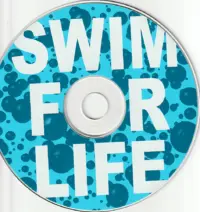
The original Swim for Life CD, recorded at the newly opened Bondi Pavilion studio following the Sydney 2000 Olympics.
Music, storytelling and a sunburnt lobster all came together to teach children about swimming, water safety and sun protection.
Forty-five minutes of fire safety
The second educational production was something quite different.
Fire safety for preschoolers.
Through J & T Natural Toys, we developed an interactive teaching kit designed for children around three years old.
And this wasn’t just a box of toys with a few instructions thrown in.
It was a complete 45-minute educational program.
The program was designed to be flexible enough for small groups or an entire childcare centre.
Sometimes a teacher would sit down with four or six children and work through the activities together. Other times, we’d have as many as fifty children participating.
Whether it was a handful of preschoolers or a room full of excited three-year-olds, the kit provided everything needed to deliver the lesson from beginning to end.
I’d written the teacher’s manual.
Every instruction.
Every piece of dialogue.
Every transition between activities.
The whole thing was scripted.
Say this.
Now take this out of the box.
Explain this.
Play song number one.
Now introduce the next activity.
Play song number two.
And so on.
There were six songs on the CD, each around a minute and a half long.
Because we’re talking about three-year-olds here.
Come on.
You can’t expect a three-year-old to sit through a ten-minute musical masterpiece about fire evacuation.
You need to get their attention, teach them something important, and move on before somebody starts eating the furniture.
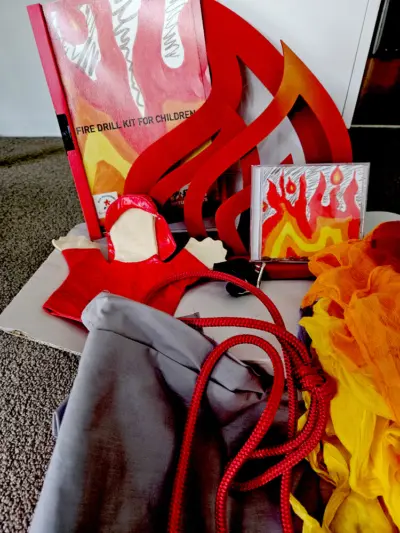
The kit included puppets, timber flames, textile materials, a book and interactive activities that helped children understand what to do in a fire.
Learning through movement, words, music and play.
It was all carefully sequenced into one 45-minute lesson.
And the beauty of it was that the teacher didn’t need to invent anything.
Everything was there.
Open the box.
Read the manual.
Follow the instructions.
Deliver the lesson.
I’d written the words that guided the entire experience.
But writing the program was only the beginning.
We still had to make everything that went inside the box.
Bringing the little red box to life
Of course, none of this appeared out of thin air.
Every component had to be designed, made and assembled.
And we weren’t exactly operating out of a manufacturing facility.
We were two women with an idea, a collection of talented people around us and a determination to turn that idea into something real.
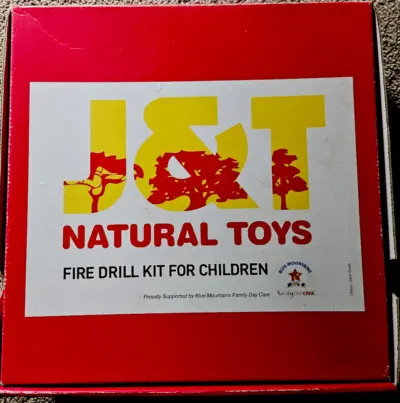
Our friend Sarah Brook designed the J & T Natural Toys logo and the sticker that went on the box.
Sadly, Sarah passed away shortly after creating those designs.
Looking at my original kit now, it’s rather special knowing her artwork is still there, all these years later.
The original J & T Natural Toys Fire Drill Kit, developed by Jacqueline and me around 2009.
The logo and box sticker were designed by our friend Sarah Brook, whose artwork remains part of the kit all these years later.
Then there were the components.
We had a carpenter make our first ten timber flames.
Ten individually made wooden flames.
That was fine to begin with, but once we needed larger quantities, we had to find a more efficient way of producing them.
Eventually, we found a business near Dee Why with a laser-cutting machine that could cut the flames in bulk.
Problem solved.
Well, one problem.
Because although the flames were now cut, they still needed painting.
Every. Single. Flame.
Jacqueline and I would spread tarps and old sheets across our gardens and cover them with timber flame pieces.
Then we’d head off to Bunnings to stock up on red, orange and yellow spray paint.
And spend the day painting.
Flame after flame, layering the colours until the plain timber shapes began to resemble fire.
There was no automated painting equipment and certainly no team of factory workers.
Just our gardens, old sheets, spray cans and two women trying to get through another batch.
And that was only the timber flames.
We had seamstresses making and hemming the fabric pieces, and a puppet maker creating the puppets.
We’d also thought carefully about how children would relate to those puppets.
They came in different skin tones to reflect Australia’s multicultural communities.
And we deliberately left their faces blank.
No facial features to suggest whether the puppet was a boy or a girl.
We wanted children to be able to identify with the characters in their own way, without gender being assigned to them.
Then there was the muslin.
Oh, the muslin.
I hand-dyed it myself.
My house looked like a Chinese laundry.
Fabric hanging everywhere, drying and waiting to become part of another Fire Drill Kit.
Eventually, we had all the individual components ready.
Which brought us to our next challenge.
Who was going to put everything together?
Lunch with a little light manufacturing
Jacqueline and I developed a rather effective way of recruiting help.
We’d invite as many friends as possible over for lunch.
How lovely.
A nice social gathering.
Except there was a small catch.
We had boxes to assemble.
Stickers to apply.
Components to sort.
And kits to pack.
So our lunches became working bees.
Friends would arrive, we’d feed them, and before long everyone had a job.
Our own little production line, fuelled by friendship and lunch.
I’m not entirely sure whether our friends realised what they were agreeing to when they accepted the invitation.
But somehow, by the end of these working bees, we had finished Fire Drill Kits ready to take into childcare centres.
And the remarkable thing is, I still have my original kit.
The very same one I packed up, carried into childcare centres and used when delivering the program.
All these years later, I can open that little red box and see the results of everything we created.
Not bad for two women, a collection of talented friends and a few lunches with strings attached.
Inside my original Fire Drill Kit: hand-painted timber flames, hand-dyed muslin, a puppet, teaching materials and music.
Every component formed part of the 45-minute fire safety program we created for preschool children.
Taking the show on the road
With our Fire Drill Kits finally assembled, it was time to take them into the real world.
I demonstrated the program at around ten preschools, where we also sold the kits. We approached early childhood education organisations too, hoping to get our little red boxes into more centres.
And then came an extraordinary opportunity.
A meeting in a high-rise building at Circular Quay, a potential business deal and the possibility of changing our lives.
But that’s another story.
And believe me, it’s a good one.
Sadly, Jacqueline passed away a few years later, and J & T Natural Toys came to an end.
Looking back now, I realise how much we’d achieved together.
And how easily I’d forgotten that writing was at the heart of it all.
I never thought of it as writing
Looking back, I’d written quite a collection of things.
Educational outlines. Teacher’s manuals. Pantomime scripts. Song lyrics. Lesson plans. Instructions. Entire teaching programs.
And I was good at it.
I still am.
There’s something satisfying about taking a jumble of information and putting it into an order that makes sense.
Beginning. Middle. End.
What does someone need to know first?
What comes next?
How do you explain something complicated without making the reader feel stupid?
But I never really thought of any of it as writing.
It was just something I could do.
Give me the information, tell me what you’re trying to achieve, and I’ll work out how to communicate it.
Which, as it turns out, became a rather significant part of my next career.
Twelve years of writing other people’s stories
In 2014, I started working as a web developer.
And in the early years, I wrote practically everything.
Clients would give me a basic framework about their business.
What they did. What they sold. Who their customers were.
And I’d go away and write the content for their entire website.
Home pages. About pages. Services. Products. Explanations. Policies.
All of it.
I’d take what they’d told me, organise it, make sense of it and turn it into something people could actually read.
Then we’d share it, review it and get the website finished.
I didn’t think much about it.
Writing was simply part of building a website.
Except, of course, it wasn’t.
It was a whole separate skill.
And one I was giving away far too cheaply.
The thousand-dollar mistake
Here’s something I’ve only recently realised.
I should have been charging more money.
A lot more.
Some of my clients couldn’t be bothered writing their own content.
And fair enough. Writing isn’t everyone’s cup of tea.
But instead of recognising the value of taking that work off their hands, I’d charge for the time it took me.
Let’s say a client needed content that would have taken them ten hours to write.
Ten hours.
At $100 an hour, that’s a thousand dollars of their time.
But because I could do it in four hours, I’d charge them $400.
Four hundred dollars.
For something they didn’t want to do, couldn’t necessarily do well, and would have spent considerably longer trying to accomplish themselves.
I was effectively penalising myself for being efficient.
The better I became at writing, the less time it took me.
And the less time it took me, the less I charged.
Brilliant business model, wasn’t it?
I wasn’t charging for the years of experience, the ability to understand a business, the skill of structuring information or the fact that I could take a pile of disconnected ideas and turn them into a coherent website.
I was charging for hours.
And eventually, I got sick of it.
Not necessarily over writing.
Over writing about businesses I wasn’t particularly interested in, for money that no longer made the effort worthwhile.
I was tired of doing the thinking for everybody else.
And the funny thing is, I’d created the problem myself.
For years, I’d made it easy.
Give me a few details and I’ll sort everything out.
So naturally, that’s what people expected.
Why would they spend ten hours struggling with something I could knock out in four?
I don’t blame them.
But I do wish I’d recognised the value of what I was doing much earlier.
By August 2025, I’d already tried to close the business.
I’d had enough.
But clients kept calling.
Some dropped away. Others stayed.
And I kept going.
Another year.
Until August 2026, when I finally closed the web development business I’d spent twelve years building.
And here’s the ridiculous part.
After all those years of being exhausted by writing, what did I decide I wanted to do next?
Write.
Of course I did.
Four hundred dollars or nothing
There’s a sentence I said recently that probably explains the whole thing.
“I’d rather write my own stuff for nothing than write their stuff for four hundred dollars.”
And I meant it.
Because the problem was never that I couldn’t write.
Or that I didn’t enjoy writing.
The problem was that I’d spent years using my ability to tell other people’s stories, often without charging what I believed the work was worth.
And eventually, the enjoyment disappeared.
Now I’m writing about my own experiences.
The people I’ve met. The places I’ve travelled. The ridiculous situations I’ve found myself in.
In 2026, I drove across Australia and became part of an extraordinary cycling journey from Broome to Bowral.
Bob Montgomery, his grandson Tom Malcolm, Jenny Montgomery and me.
And Lucky, of course.
Thousands of kilometres. Countless stories.
Some funny. Some difficult. Some heartbreaking.
For weeks, my attention was on the boys and the journey.
Getting them fed. Getting them safely through each day. Finding places to stop. Recording what happened.
And then, after we came home, trying to make sense of everything that followed.
I was so busy being part of their story that I hadn’t given much thought to my own.
The writer who didn’t know she was one
I’ve finally had a chance to stop, catch my breath and reflect on everything that’s happened.
And something unexpected has happened.
My brain has started looking for content.
It’s as though someone has opened the filing cabinets in my head, and decades of forgotten memories are suddenly spilling out.
Every time I open another drawer, there’s something else in there.
Something I’d completely forgotten I’d done.
And I’m beginning to realise just how much of my life I’ve spent writing.
Not always for money.
Not always professionally.
And certainly not with any grand ambition of becoming a writer.
Sometimes I was teaching. Sometimes I was coding. Sometimes I was running a business. Sometimes I was helping people understand something complicated.
And sometimes I was just having a good laugh.
But the words were always there.
I suppose I was so busy getting on with life that I never stopped to consider how much writing was part of it.
The difference now is that I’m no longer waiting for someone else to give me something to write about.
I’ve got plenty of my own material.
More than enough, actually.
And I’m finally giving myself permission to write it.
Not because someone commissioned me.
Not because there’s a website to finish.
Not because there’s an invoice attached.
Just because I want to.
It’s taken me a surprisingly long time to recognise something that was there all along.
I never stopped being a writer.
I just stopped writing for everyone else.
And now, with a little breathing space, I’m listening again.
The road is calling.
There are more places to explore, more people to meet and, no doubt, more stories waiting to be told.
And somewhere out there, I’ll find the story that defines what comes next.
About Me
I’m a content writer and storyteller drawn to people, places and the details that make a story worth telling. Sometimes the smallest moments tell the biggest stories.
Every story has a voice. I help you find the words.
Contact Details
Phone: +61 0449 684 588
Email: letschat@wordafterword.com
Web: www.wordafterword.com
Leura, NSW, 2780
